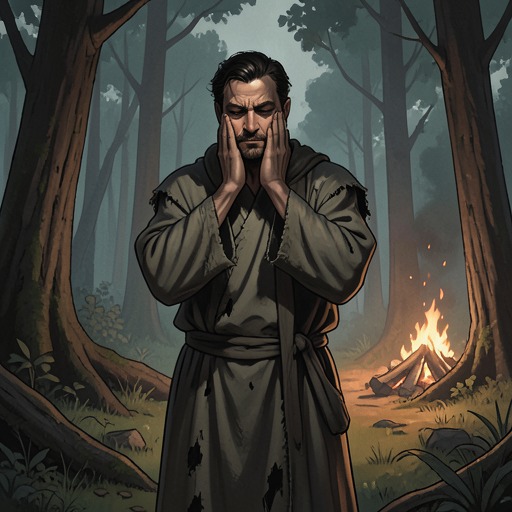
Viktor
Narcissus and GoldmundViktor is a veteran wanderer whose resourcefulness and comic bravado make him both a guide to life on the road and a threat to Goldmund. Calling himself a traveling student and styling himself the peasant terror, he moves through the countryside by wit, performance, and opportunism. His short companionship gives Goldmund practical lessons in survival, but ends when Viktor attempts to rob him and Goldmund kills him in self-defense. The event haunts Goldmund long after the two men part, turning Viktor into a recurring figure in his thoughts about violence, mortality, and the disappearance of a human life.
Identity and Life on the Road
Viktor appears in a village where Goldmund has stopped after a night that brought him into contact with a birth and a new amorous encounter. Described as lanky and daring, he looks half like a priest and half like a highway robber. He greets Goldmund with scraps of Latin and claims to be a traveling student, although his student years are long behind him. The contrast between scholarly language and the life of a vagabond is central to his self-presentation: Latin is less a sign of an orderly academic life than one more resource in his repertoire.
His extravagant account of himself mixes invented grandeur with the necessities of the road. He boasts of visiting Cologne and Paris, of presenting a dissertation at Leyden on the metaphysics of liverwurst, and of being related to the king of Bohemia. At the same time, he describes himself as tormented by hunger and thirst, and jokes that his occupations include teaching Latin to young wives and obtaining sausages from chimneys. His professed ambition to reach a mayor’s wife’s bed and his mock prospect of becoming an archbishop belong to the same irreverent performance. Goldmund, unfamiliar with this kind of gallows humor and wayfaring Latin, is initially frightened by him, but finds enough charm and companionship in Viktor to agree to travel together.
A Teacher of Survival
Viktor’s knowledge is practical and accumulated. When the two men set out, he approaches each household as a place where food or some other contribution might be obtained. He speaks of the war in Italy, sings the song of the battle of Pavia, offers remedies to older women, and draws on both broken Latin and thieves’ slang. He frightens some people and flatters others, presenting himself in turn as scholar, storyteller, and worldly authority. While he talks, he watches the people around him closely, registering faces, drawers, food, and the signs of what a house might yield.
Goldmund recognizes that this performance has been learned through hardship. Viktor has experienced hunger and cold, and has become shrewd and impudent in the effort to survive a dangerous, meager existence. The knowledge he passes on is concrete: how to detect signs of human habitation in winter, assess a possible place to sleep, and judge a household’s prosperity, generosity, curiosity, or fear. He organizes the homeless traveler’s needs around avoiding death, finding shelter, and securing food. His expertise offers Goldmund an education that the younger man has not needed to acquire as quickly, because his youth and appearance often make people more willing to welcome him.
Viktor also makes the limits of that advantage plain. He predicts that Goldmund’s youthful face and fine clothes will not protect him indefinitely: age, worn clothing, and visible hunger may make him an unwelcome guest, requiring a harder kind of resourcefulness. Yet Goldmund resists the idea of treating every encounter as a calculation. He believes that a friendly request has usually been enough to secure hospitality, while Viktor sees such trust as a temporary privilege that cannot be relied upon. Their difference is not simply in temperament; it reflects two responses to the insecurity of wandering, one built around watchfulness and opportunism, the other still open to encounter.
Goldmund, Lydia, and the First Breach of Trust
Viktor’s easy manner conceals an interest in Goldmund’s possessions. As they walk, he runs his hands along Goldmund’s clothes and searches their seams and pockets. Goldmund draws back, remembering the gold coin hidden among his belongings. When Viktor asks why he left a comfortable house in winter, Goldmund tells him about the knight’s two daughters, Lydia and Julie. Viktor regards Goldmund’s departure as foolish and proposes that they return to the knight’s house. Goldmund, he suggests, can write Lydia a letter, while Viktor goes to obtain money and other valuables.
Goldmund refuses. He will not identify the knight or tell Viktor how to find the house, and the suggestion provokes their first quarrel. Viktor frames the plan as a missed opportunity and teases Goldmund about supposedly returning to marry Lydia; Goldmund will not accept the joke as harmless once he sees the prospect of theft behind it. The conflict reveals a sharp divide in their idea of companionship. Viktor treats Goldmund’s connection to Lydia as a possible means of securing goods, while Goldmund regards the relationship and the gifts associated with it as private and refuses to turn them into a scheme.
The gold coin is especially important because it is part of Lydia’s farewell gift. She has sent it concealed in a piece of ham, together with a thick knitted wool vest she made for Goldmund. Goldmund continues to wear the vest, and the coin remains something he is unwilling to surrender. What Viktor sees as a valuable object has, for Goldmund, a history of affection and separation; this difference gives the later theft attempt an emotional as well as material stake.
The Fatal Struggle
Goldmund’s unease grows while the two men rest. He regrets having told Viktor about Lydia and wishes he could find a way to part from him. Later, when Viktor approaches him again and feels through his pockets and clothing, Goldmund confronts him. Viktor responds by attacking him, and Goldmund, fearing that he is about to die, manages to reach his small hunting knife and fight back. Viktor dies, and Goldmund is left alone with the immediate knowledge that he has killed a man.
The aftermath is abrupt and disorienting. Goldmund takes up his knife and runs from the place, leaving the body behind. As morning comes, he washes away the blood on his face in the snow, then wanders for another day and night, aimless and distressed. His physical needs eventually interrupt his fearful remorse, but they do not resolve it. The narrative presents the killing as a response to a struggle for survival, while preserving its lasting moral and emotional weight for Goldmund.
The missing coin becomes bound up with that weight. When Goldmund later recovers in a stable, he worries that he has lost it. He thinks of the coin not only as the sole remaining gift from Lydia, since the vest was left with Viktor, but also as the reason he defended himself. He fears that if the coin has disappeared, the terrible experience will have been left without even that tangible remainder. The peasant woman Christine tells him she found it when she laid him down on the straw. The object survives, but it cannot make the killing simple or erase the cost of what happened.
Afterlife in Goldmund’s Memory
Viktor does not vanish from the story when Goldmund leaves him behind. In later moments of melancholy, Goldmund remembers the lanky wanderer he stabbed and wonders what remains of his body and of the life that once produced his stories and jokes. His thoughts move from the possible disappearance of Viktor’s physical remains to the possibility that nothing of him survives except the memories held by others. He wonders whether the women who once loved Viktor still dream of him, and whether even those traces will fade.
That meditation expands beyond Viktor. Goldmund connects the loss of the wayfarer to the fading of his own earlier hopes, including the excitement with which he had once approached art and Master Niklaus. Achievements and desires that had seemed enduring can, with time, feel as insubstantial as a remembered silhouette. Viktor therefore remains more than Goldmund’s former traveling companion: his death gives concrete form to the novel’s recurring attention to the fragility of life and memory. The road-wise man who had taught Goldmund how to survive becomes, in Goldmund’s recollection, a reminder that survival cannot prevent a life from disappearing.